Traffic Decisions
This page explains how the traffic makes its choices, with the numbers the code uses. Use it to check a decision you see on the airport map: why a stand pushed onto that taxiway, why an aircraft stopped, why a route takes a longer way, or why a departure is still waiting. Each number names its constant and the file it is in. Behaviour is described as the code does it today. Where something is unclear, the page says so.
The API around these decisions is described in Departure Taxi, Airport Layout & Taxi Routing, Airborne Separation and Radio.
Units. Ground costs are in meters of taxiing. A route of cost 1200 is as good as 1200 m of straight taxiway with no turns, so a penalty of 400 means “worth 400 m of taxiing to avoid”.
Diagrams. Flow charts are images in docs/images/traffic-decisions/. Geometry is drawn in text, north up and not to scale.
Pushback choice
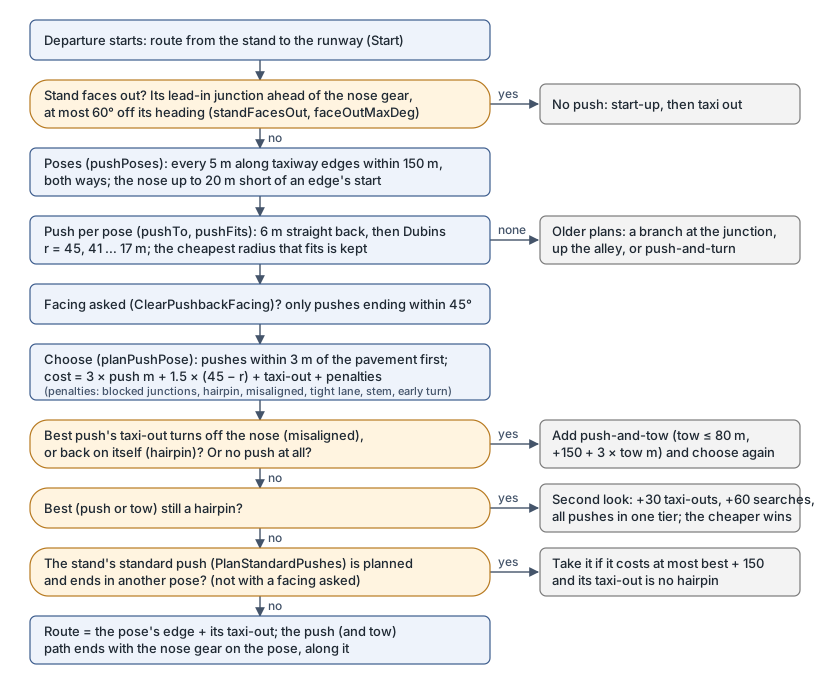
An injected departure (TaxiWithInjector) plans its pushback when it starts (TaxiController.Start → planPushback). The push is planned to where it ends, not along the stand’s lead-in line. The planner picks a pose: the nose gear on a taxiway, the aircraft along it, facing the way it will taxi out. Then it finds a path the tug can push to that pose. The code is in pkg/traffic/pushpose.go; the shared constants are in pkg/traffic/departure_inject.go and pkg/traffic/tunables.go.
Face out or push
A stand faces out when the lead-in junction of the route from it lies ahead of the parked aircraft’s nose gear, at most faceOutMaxDeg (60°) off the stand heading (standFacesOut, departure_inject.go). The aircraft then starts up and taxis straight out, with no push. Being ahead of the stand’s reference point is not enough. If the junction lies under the aircraft, behind its nose gear, the stand is pushed (EDDF B10, KJFK A15). This is decided once, when the departure starts.
Poses
pushPoses lists every pose a push may end in:
- every
pushPoseStepMeters(5 m) along every taxiway edge whose nodes are withinpushPoseReachMeters+ 300 m of the main gear, in both directions; - with the nose gear at most
pushPoseReachMeters(150 m) from the main gear; - also up to
laneEndPoseMeters(20 m) short of an edge’s start, on its line. The nose is then short of where the lane begins and the tail is on the apron behind it (LKPR C31, C17).
Some edges never hold a pose:
- runways, paths along a runway, and stand lead-ins (
pushEdge); - the branches of a forked lead-in: a stand junction that splits into unnamed branches less than 90° apart, all meeting the same named taxiway (LFPG M,
forkedLeadIns); - edges of a taxiway whose span limit the type exceeds (
airport.KnownTaxiwayMaxSpan: LKPRJOandJBare limited to 36 m); - edges from which there is no way to the runway.
Two kinds of pose are allowed but marked, and they cost more (see the cost table below):
- stem: a single unnamed stem off a stand, which may be a lead-in or an apron lane (
leadInStem); - tight: a lane without wingtip clearance from the stands beside it (
Graph.Fitsfails).
Every pose gets a lower bound on its cost: max(0, distance − wheelbase) × 3 for the push, plus the shortest graph distance from the pose to the runway’s holding point (metersToRunway). Poses are tried cheapest bound first. A taxi-out is planned only for the pushes that could still win: at most pushPoseRoutes (30) taxi-outs in at most pushPoseSearches (60) route searches.
The push to a pose
   pose: nose gear on the taxiway, facing the way out
        o------->  heading
        |
        |<- wheelbase ->|            the push ends with the main gear
        *===============o            one wheelbase behind the nose gear
       main gear
          \
           \   Dubins path: shortest path of turn radius r
            \  (r = 45, 41, 37, ... 17 m; the cheapest that fits)
             |
             |  PushStraightMeters (6 m) straight back first
           [stand]
pushTo takes the main gear PushStraightMeters (6 m) straight back off the stand, then the shortest path of turn radius r (a Dubins path, pushturn.go) to the point one wheelbase behind the pose’s nose gear. The path arrives along the pose’s heading. Radii run from PushbackArcMeters (45 m) downwards in 4 m steps while r ≥ PushbackMinArcMeters − 0.01. With PushbackMinArcMeters at 14 m, the tightest radius tried is 17 m. Each radius below 45 m costs pushTurnRadiusCost (1.5) per meter, and the cheapest radius that fits is kept for the pose.
A push fits (pushFits) when all of these hold:
| Check | Limit | Constant |
|---|---|---|
| Path length | ≤ 150 m | pushPoseMaxMeters |
| Total heading change along the path | ≤ 200° | pushMaxTurnDeg |
| Heading change beyond the net turn from stand to pose (no loops) | ≤ 60° | pushMaxSwerveDeg |
| Main gear off the pavement | ≤ 8 m | pushOffPavementWideMeters |
| Nose and tail at the pose off the pavement | ≤ 8 m | pushOffPavementWideMeters |
| Tail, wingtips and nose inside a neighbouring stand or the terminal zone | no deeper than the parked aircraft already is, plus 1 m | pushClearanceSlackMeters |
Pavement. The pavement is modelled from the scenery’s taxi data (pavementAround, laneEnds and junctionFillets in pushpose.go). It is made of:
- the stand circles;
- the taxi path strips, half their width either side (12.5 m when the width is unknown);
- 45 m of apron past the end of a lane that dead-ends or turns into an unnamed connector (
laneEndMeters; the lane does not go on withinlaneEndDeg, 30°); - a disc at every junction or bend of 30° or more,
filletMeters(10 m) beyond the widest lane there.
A push whose main gear stays within pushOffPavementMeters (3 m) of this pavement, with its pose’s nose and tail too, is near. The others are on the “wider apron” and only win when no near push exists (see Choosing).
Neighbouring stands (flatPave.withStands, intrusion):
- Counted: stands within 200 m of the stand. Not counted: the aircraft’s own stand, the stands that overlap it (
Layout.ParkingConflicts: nobody parks there while it is taken) and standsTaxiRequest.StandOccupiedreports empty. WithoutStandOccupied, every neighbour counts as taken. - The terminal zone of every gate always counts, taken or not. It starts 5 m before the gate’s parked nose (
pushTerminalMarginMeters), reachespushTerminalDepthMeters(40 m) towards the building, and is as wide as the stand’s radius. - Sampled points: along the push, at every second path point, the tail (
TailMetersbehind the main gear, default 20.5 m), both wingtips (half the span either side of a point 2 m ahead of the gear) and the nose (pushNoseFactor1.35 wheelbases ahead).
The push is planned again when it begins if a neighbouring stand has been taken or freed since (startPushback).
Cost
Each push to a pose costs (planPushPose, the choose closure):
| Term | Value | Constant (file) |
|---|---|---|
| Push length | 3 × meters pushed | pushCostFactor (departure_inject.go) |
| Turn radius given up | 1.5 × (45 − r) | pushTurnRadiusCost |
| Taxi from the nose to the far node of the pose’s edge | meters | pushPose.taxi |
| Taxi-out from that node to the runway | the route’s search cost (length plus the routing penalties) | Graph.RouteToRunwayFrom |
| Each junction of another named taxiway under the aircraft at the pose | +400 | pushBlockPenalty |
| Hairpin: the taxi-out turns back by ≥ 110° within 200 m, counting the corner at its first node seen from the nose | +1000 | pushHairpinPenalty, pushHairpinDeg, pushHairpinMeters |
| Misaligned: the taxi-out point 10 m ahead of the nose is more than 20° off its heading, or the point 20 m ahead more than 45° | +2000 | pushMisalignPenalty, pushTaxiStart*, pushTaxiAlign* (pushpose.go) |
| Tight lane | +500 | pushTightPenalty |
| Pose on an unnamed stem off a stand | +400 | pushLeadInPenalty |
| Early turn: degrees the taxi-out lies off the nose 30 m ahead | 3 × degrees | pushEarlyTurnCost, pushEarlyTurnMeters |
Blocked junctions (poseBlocks). A junction counts when it has three or more edges and one of them is a named taxiway other than the pose’s lane (not a stand). It must lie under the aircraft standing at the pose:
                 <-------- wheelbase + tail --------><- 0.35 wb ->
   ^          +----------------------------------------------+
   half span  |                                              |
   v          tail ===================*==============o====> nose tip
   ^          |                     main            nose     |
   half span  |                     gear            gear     |
   v          +----------------------------------------------+
   a junction of another taxiway inside the box: +400 each
   (not the junction of the stand's own lead-in)
Hairpin from the nose (pushPose.hairpin). The taxi-out route starts at the node ahead of the pose, so its own shape misses the corner at that node. The corner is therefore also checked from the nose: nose → first route point → second route point.
   nose o------------>+ first node of the taxi-out
                     /
                    /  turns back 127° here: a hairpin (+1000)
                   /
This is LKPR B9 for 24 before the fix: facing east 23 m short of B2’s junction, then 127° round onto B1, a 130 m loop in the sim (comment on hairpin).
Misaligned and early turn. Both look along the taxi-out from the nose:
   nose o----------|----------|----------|------>  pose heading
                  10 m       20 m       30 m
        point 10 m ahead > 20° off  -> misaligned (+2000)
        point 20 m ahead > 45° off  -> misaligned (+2000)
        point 30 m ahead: 3 per degree off (early turn)
The early-turn cost decides between two poses that are both aligned: the one already facing along the taxi-out wins (pushEarlyTurnCost comment: LKPR A3 for 24 goes onto A1 facing north, not onto AA facing west and turning onto A1).
Choosing
- Facing asked. If the push was cleared with
ClearPushbackFacing("west"), only pushes ending withinpushFacingDeg(45°) of that compass heading are kept. If none ends that way, all of them are kept. Once the push has begun the call returnsErrTooLate. - Two tiers. Near pushes (within 3 m of the pavement) compete first. Pushes on the wider apron (within 8 m) are considered only if no near push has a taxi-out. Within a tier the lowest cost wins.
- Push and tow. If there is no push at all, or the best push is misaligned or a hairpin,
pushAndTowadds candidates. The tug pushes to one pose (one of the 12 cheapest pushes,towPushes), then tows the aircraft forward to another pose. The tow is at mosttowMaxMeters(80 m) and endstowAlignMeters(20 m) straight along the pose, at radii 45 down to 17 m. A tow costs 3 per meter, plustowPenalty(150), plus the radius term. It has the same pavement (8 m) and neighbour checks as a push. Then the choice is made again. A push onto the taxiway facing the runway is never turned round by a tow. - Second look. If the winner is aligned but still a hairpin, the budget grows by 30 taxi-outs and 60 searches. Near and wider-apron pushes then compete in one tier. The result is taken only if it is cheaper.
- Standard push. If the stand has a standard push (see below), no facing was asked, and the winner ends in another pose, the pushes ending in the standard pose are considered (one tier, extra budget). One is taken if it costs at most
standardPushMargin(150) more than the winner and its taxi-out is no hairpin. Two poses are the same if they are on the same edge, in the same direction, within 30° (samePose). - The departure route becomes the pose’s edge plus its taxi-out. The push (and the tow) ends with the nose gear on the pose, along it.
Standard push per stand (PlanStandardPushes(graph, model, stands)). For each stand, the push is planned for each end of the airport’s two longest runways, with the stand’s neighbours all taken. If one pose is chosen by more than half of those ends, and by at least two of them, it becomes the stand’s standard push. Departures planned before this finishes plan as usual. SaveStandardPushes writes the plans so far (each stand: the pose edge and heading, or none), and LoadStandardPushes reads them back. A file saved for another layout of the airport, or by another planning version, is refused with ErrStandardStale. The airport map plans an airport when its first departure appears, for FSLTL_B738_RYR (standardPushModel in cmd/airport-map/main.go). It plans one airport at a time and one stand at a time, resting after each stand so it uses about 30% of one core. The plans are saved to the user cache folder (mrlm-simconnect/airport-map/pushes/ICAO.json), so later starts load them instead of planning again. The standard pose is only a preference. A type that cannot make that push gets no candidate in that pose and keeps its own choice.
When no pose is reachable
A few stands have no reachable pose (for example remote stands far from a taxiway). They use the older plans in departure_inject.go (choosePushback, described in Injected pushback). Their numbers:
| Rule | Value | Constant |
|---|---|---|
| Swing of the tail onto a branch at the junction | ≤ 100° | maxPushSwingDeg |
| Wider swing, only when no ordinary push leaves the taxiways clear (none, or each blocks a junction) | ≤ 125°, +150 | maxPushSwingWideDeg, pushWideSwingPenalty |
| Straight on (a swing under 45°) across a named taxiway behind the stand | not allowed (except up an alley) | minPushSwingDeg |
| Junctions considered: the first, and on along the route up to 250 m with no bend over 45° | pushAlleyMeters, pushAlleyTurnDeg |
|
| A straight push to a later junction: within 150 m, 25° of the push direction, 3 m of the stand axis; otherwise an alley push | pushCorridorMeters, pushCorridorDeg, pushOffAxisMeters |
|
| Cost | taxi-out + 3 × meters pushed + 400 × blocked junctions | pushCostFactor, pushBlockPenalty |
Blocked: junctions within half span + 5 m of the body (wheelbase + PushTailMeters 20 m + tail along the lane); up an alley also every junction of another taxiway passed, and every crossroads of three branches leading on 80 m or more |
pushBlocks, alleyBlocks, crossroadsBranchMeters |
|
| Hairpin (≥ 110° within 200 m) / misaligned (> 60° within 20 m) | +1000 / +2000 | pushHairpin*, pushMisalign* |
| Push-and-turn on the apron instead: no branch, or the best one is a hairpin or misaligned and a clean push-and-turn fits | cleanPushTurn |
|
Pushes tried before keeping the last: tightest turn ≥ 11 m (PushbackMinArcMeters − 3) |
6 | pushPlanTries, pushPathFits |
Worked examples at LKPR
The numbers below come from running the planner on the LKPR test data (pkg/airport/testdata/LKPR.json) for FSLTL_B738_RYR, with every neighbouring stand taken. Costs are rounded. The taxi-out cost includes the turn and crossing penalties, so it is larger than the route’s length. Different scenery, a different type or empty neighbours can change them.
A3: onto A1, facing north-north-west
A3 faces 245°, away from A1. Its lead-in meets A1, which runs north-north-west to Z; AA leaves the same junction to the east.
              to Z (06, 12, 30) / A (24)
                  ^  A1
                  |
                  o  nose gear 6 m up A1, facing 339°
                 /|
   [A3]=========+-+------ AA (east)
   faces 245°     |  A3's lead-in junction (its own: never counted as blocked)
                  |  the aircraft lies along A1, tail to the south
                  |
                  A1 (south)
The push is 92 m at r = 17 m: 3 × 92 + 1.5 × (45 − 17) ≈ 317.
| Runway | Pose | Push | Nose to node | Taxi-out | Early turn | Total | Tier |
|---|---|---|---|---|---|---|---|
| 24 | AA facing 359° | 341 (104 m) | 25 | 568 | 6 | 939 | wider apron |
| 24 | A1 facing 339° | 317 (92 m) | 26 | 611 | 1 | 955 | near: chosen |
| 06 | A1 facing 339° | 317 | 26 | 4569 | 1 | 4913 | near: chosen |
| 06 | A1 facing 334° | 330 | 6 | 4575 | 2 | 4913 | wider apron |
For 24 the AA pose is cheaper, but its push leaves the modelled pavement by more than 3 m, so the near push onto A1 wins. Pushes for 12 and 30 also end on A1 facing 339°. A1 is also the standard push. The taxi-out for 06 is A1, Z, H, F, spoken “Z, H, F”: the run on A1 is shorter than 150 m (spoken taxiways).
A5: onto B1, nose on its own junction
A5 faces 065°. Its lead-in meets B1, which runs north-north-west to H and Z. B2 leaves B1 to the west, 45 m further south.
            to H (06, 12, 30) / Z (24)
                 ^  B1
                 |
      A5 lead-in o======================[A5]   faces 065°
                 |  nose gear on A5's junction, facing 328°
                 |  aircraft along B1, tail about 36 m down it
                 |
     B2 <--------+  B1/B2 junction: just behind the tail, not blocked
                 |
B1 (south, to A6, A7)| Runway | Pose | Push | Nose to node | Taxi-out | Total |
|---|---|---|---|---|---|
| 24 | B1 facing 328° | 227 (62 m) | 35 | 870 | 1132 |
| 24 | B1 facing 328°, 30 m further | 225 (61 m) | 4 | 905 | 1134 |
| 24 | B2 facing 282° | 335 (98 m) | 32 | 981 | 1348 |
| 06 | B1 facing 328° | 227 | 35 | 4275 | 4538 |
| 06 | B2 facing 282° | 335 | 32 | 4275 | 4643 |
All four runway ends push onto B1 facing 328°. Two earlier failures shaped the rules here:
- KLM594 was pushed onto B1 facing south-east, taxied 80 m and turned 127° back onto B2. The hairpin penalty now prevents this (comment on
hairpinAfterPush). - For 24, aircraft were pushed 134 m west into the crossroads of the B1 lanes (#489). Crossroads now count as blocked junctions in the older alley plans (
alleyBlocks).
B9: the standard push onto B2
B9 faces 213° at the end of an alley of B2. The planned pushes go 100 m back across the apron behind the stand, to the lane where B1 and B2 fork.
              B1 (north, to Z: the way to 24)
               ^
               |      B2 (west, to H: the way to 06, 12, 30)
   B2 <--------+---o  nose gear 8 m short of the fork, facing 298°
              /|      (the standard push)
             / o  nose gear on B1 facing 327° (24 alone, without the standard push)
            /  |
           /   push about 100 m back across the apron
          /
[B9] faces 213°| Runway | B2 facing 298° | B1 facing 327° | Without a standard push | With the standard push |
|---|---|---|---|---|
| 06 | 4716 | 4721 | B2 | B2 |
| 12 | 1835 | 1840 | B2 | B2 |
| 30 | 3589 | 3594 | B2 | B2 |
| 24 | 1421 | 1315 | B1 | B2 (106 more, within 150) |
Three of the four ends choose B2, so B2 facing 298° becomes the stand’s standard push. For 24 the B2 push costs 106 more than B1, which is within standardPushMargin (150). B9 therefore pushes the same way for every runway (TestStandardPush).
C17: onto JB, the tail past the lane’s end
C17 faces 214°. Its lead-in junction is where JB begins and runs west-north-west. An unnamed connector goes on from the junction to J.
                                 J
                                /  unnamed connector to J
   (west, to H) <--- JB ---o---+   C17's lead-in junction: JB starts here
                           |    \
             nose gear 11 m |     \  tail over the apron past JB's end
             up JB, 304°    |      \ (laneEnds: 45 m of apron counted)
[C17] faces 214°| Runway | Pose | Push | Taxi-out | Total |
|---|---|---|---|---|
| 24 | JB facing 304° | 238 (65 m) | 1382 | 1656 |
| 24 | J facing 305° | 328 (95 m) | 1358 | 1739 |
| 24 | JB facing 304°, push 64 m + tow 25 m | 458 | 1382 | 1858 |
All four runway ends push onto JB facing 304°. The tow would cost about 200 more (tow meters × 3 + 150). Here it is not even planned, because the best push is aligned and no hairpin. JB is limited to 36 m of span (KnownTaxiwayMaxSpan): a B738 (35.8 m) may end on it, a wide-body may not.
Ground give-way
Injected aircraft at one airport share a GroundPicture (pkg/traffic/awareness.go). Each aircraft reports where it is, its heading and its body every frame:
- nose: 1.35 wheelbases ahead of the main gear (
pushNoseFactor), measured from the reference point; - tail:
TailMeters+RefAheadMetersbehind the reference point.
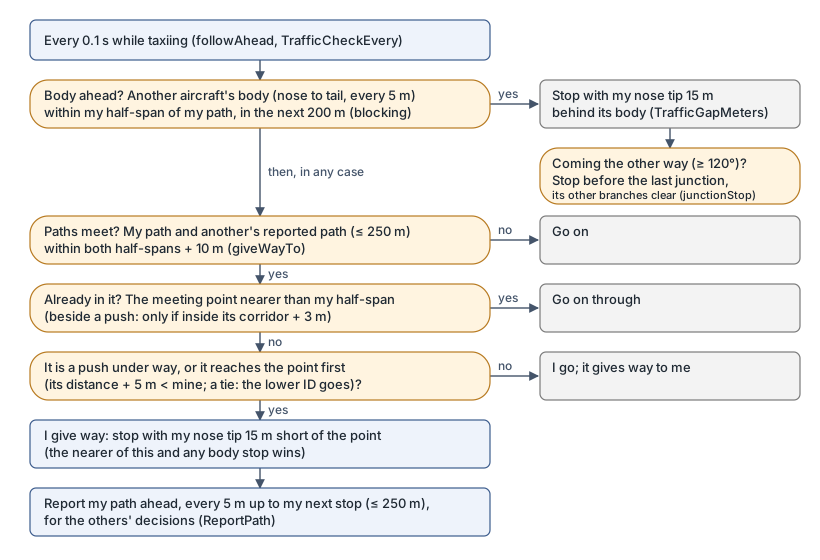
While taxiing it also reports its path ahead every trafficBodyStep (5 m), up to its next stop, at most GiveWayLookMeters (250 m). An aircraft holding at a limit or a hold-short reports no path, so it takes no priority. Reports older than TrafficStaleAfter (3 s) are ignored. A taxiing aircraft looks again every TrafficCheckEvery (0.1 s) (groundDrive.followAhead in ground_drive.go).
Body ahead and the gap
blocking finds the nearest point of another aircraft’s body (nose to tail, every 5 m) within the aircraft’s own half-span of its path, in the next TrafficLookMeters (200 m). The aircraft stops with its nose tip TrafficGapMeters (15 m) behind that point. The nose tip is (pushNoseFactor − 1) × wheelbase ahead of the nose gear (4.4 m for the default 12.6 m wheelbase). It moves on as the other moves.
   me  o==>                                  [ other's body ]
       |------- stops here --|<--- 15 m --->|
                     nose tip
Who gives way where paths meet
giveWayTo compares the aircraft’s path with every other reported path. Waiting aircraft (pushed, waiting for the taxi clearance) are left out here. The two paths meet at the first point of the aircraft’s path within both half-spans plus GiveWayMarginMeters (10 m) of the other’s path. For two aircraft with the default 35.8 m span that is 17.9 + 17.9 + 10 = 45.8 m.
                 | other's path
                 |
   me ==>--------x-------->      x: the first point of my path within
                 |                  my half-span + its half-span + 10 m of its path
v- Already in it. The meeting point is closer than the aircraft’s own half-span, so it goes on through. Beside a push under way this applies only if its first point is already within both half-spans plus
PushClearMarginMeters(3 m) of the push corridor. Otherwise each would wait for the other (#452). - Who goes. Each side measures how far along its own path the meeting point lies; the other’s distance gets +5 m because its reported path starts one step ahead of it. The aircraft further from the point waits. On a tie the lower object ID goes. Both sides compute the same thing, so exactly one of them stops.
- A push under way always has priority. Taxiing traffic whose path meets the push corridor gives way whatever the distances.
- The one giving way stops with its nose tip 15 m short of the meeting point. If both a body stop and a give-way stop apply, the nearer one wins.
Oncoming traffic keeps the junction clear
When the body ahead faces at least oncomingDeg (120°) off the path, the aircraft does not queue up to the 15 m gap (#444). That would leave its nose over the junction where the other aircraft has to turn off. junctionStop finds the last junction on its path before the stop. It walks that junction’s other branches for junctionBranchMeters (60 m), leaving out the branches within 20° of the path back or ahead. It then steps back 2 m at a time until the aircraft, from the nose gear to the nose tip, is at least max(my half-span, its half-span) + 10 m clear of those branches. If no place behind is clear, it stops where it is.
                      branch the other aircraft turns into (60 m kept clear)
                         |
   me ==>-----o  stop    J ------------------<== other, coming the other way
              |<-- clear of the branch by the larger half-span + 10 m
Pushbacks
Before the push starts (pushBlocked), even when cleared, the push waits if any of these is in its corridor (the push path, the tail beyond its end and any tow, corridorBlocked with paths):
- another aircraft’s fuselage within the half-span + 3 m (
PushClearMarginMeters) of the corridor. If that aircraft is moving (it reports a path), its own half-span is added, so its wing keeps clear too (#446). - another aircraft’s reported path within both half-spans + 10 m. This includes a taxiing aircraft’s path, a neighbour’s push and the planned taxi of an aircraft waiting after its push. Two pushes into one corridor would otherwise each stop for the other (#452).
Before the stand is given (StandAllocator.Assign), neighbours due off together are kept apart: a stand within 90 m (StandPushNeighbourMeters) of one whose aircraft is due off within 8 minutes (StandPushConflictWindow) of this one ranks as if its taxi-in were up to 600 m (StandPushConflictMeters) longer, the full amount for the same time and less as the times are further apart (pushConflict, stands.go). The map’s schedule gives departures their STD and arrivals their turnaround’s STD.
Under way (holdPushForTraffic) the push reports what it still sweeps (ReportPush), and taxiing traffic gives way to it. The push itself stops only for a fuselage within the half-span + 3 m of what it still has to sweep. An aircraft that stopped short to give way would otherwise hold it for ever (#466). It brakes to a stop v² / (2 × 0.25) + 0.2 m ahead, using the push profile’s 0.25 m/s² deceleration. TaxiEvent.PushbackHeld reports the hold.
Service vehicles
Tugs and fuel trucks give way to aircraft on their way to and from their depot (vehicle_yield.go, GroundPicture.VehicleConflict). The vehicle looks VehicleLookMeters (40 m) ahead along its way. It stops VehicleStopShortMeters (3 m) short of the first point that comes within both half widths plus VehicleClearMeters (8 m) of a moving aircraft. That means the aircraft’s body, or the first VehicleAircraftLookMeters (120 m) of its path ahead. It waits there until the aircraft has passed. A vehicle already in an aircraft’s path (within VehicleCommitMeters, 4 m, of its front) drives on to clear it. Parked aircraft and aircraft waiting for a clearance do not count, since the roads pass them, and neither does the vehicle’s own aircraft. Aircraft do not see the vehicles and keep their way. At LKPR B9 a tug meeting an A320 taxiing across its road stops about 29 m short of the crossing.
Vehicles also respect each other. Each tug and fuel truck reports itself to the airport’s ground picture (ReportVehicle). On the roads it drives VehicleLaneMeters (2 m) right of the centreline, blended in over the first and last 15 m of its way, so oncoming vehicles pass each other. It stops VehicleStopShortMeters (3 m) short of another vehicle’s body within both half widths plus VehicleGapMeters (3 m) of its way, as follows:
- ahead of it: it waits behind and follows;
- behind it: it ignores it, since that one waits;
- side by side (two leaving one depot together), or crossing: the one with the higher object ID waits, so two never wait for each other.
After VehicleWaitMax (1 min) waiting for vehicles, it drives on regardless for 20 s, so one parked on its way cannot hold it for ever. At LKPR two tugs leaving the same depot for B9 and B10 together keep at least 4 m apart.
Braking
| Value | Constant (tunables.go) | |
|---|---|---|
| Normal stop | up to 1.5 × the profile’s Decel (default 0.5 m/s²) |
GroundMover.step |
| Stop for traffic found inside the normal braking distance | up to TrafficBrakeFactor (3) × Decel, jerk TrafficJerkFactor (6) × Jerk |
|
| Roll on into the gap rather than stop dead | up to TrafficOverrunMeters (8 m) past the stop point |
|
| Holding short of a runway crossing | nose gear HoldShortStopMeters (7 m) before the line |
Taxi routing
Taxi routes come from a turn-aware Dijkstra search over (node, arrived-from) states in pkg/airport/route.go. A route’s Cost is its length plus these penalties; Length stays the real length. Zero in a RouteOptions field selects the default, and a negative value disables the cost (see Route cost).
| Cost | Default | Constant |
|---|---|---|
Turn at a junction (a node with more than two edges): 60 × (angle − 15°) / 90° |
a 90° turn: 50, a 45° turn: 20 | DefaultTurnPenalty, TurnFreeAngle |
| Turning (more than 15°) at a junction from one named taxiway onto another; unnamed connectors carry the previous name | +40 | DefaultTaxiwayChangePenalty |
| Turning back, ≥ 150°, at any node | +2000 | UTurnAngle, UTurnPenalty |
| Each runway the edge enters (not the one it starts on: vacating or lining up is no crossing) | +1000 | DefaultRunwayCrossingPenalty |
| Taxiway edge along a runway surface | × 20 its length | AlongRunwayFactor |
| Edge touching a node where a stand connects (apron taxilane), except within 250 m of the start | + 0.5 × its length | DefaultApronPenalty, DefaultOwnApronMeters |
| Leaving a stand through a lead-in behind it (a pushback) | +200 | DefaultPushbackPenalty |
| Entering a stand through a lead-in ahead of it (turning round on the apron) | +3000 | DefaultStandTurnAroundPenalty |
Named taxiways off a Taxiways custom route (not the current or the next one) |
× 10 their length | OffTaxiwaysFactor |
For example, a 90° turn from B1 onto H at a junction costs 50 + 40 = 90 m of taxiing. Going straight on where the name changes costs nothing. A 150° U-turn onto another taxiway at a junction costs 2000 + 90 + 40.
Fit. With HalfSpan set, an edge is used only if its clearance is at least the half-span plus DefaultWingtipMargin (3 m). The aircraft’s own stands do not count as obstacles. The edge is also refused if the taxiway’s span limit is exceeded (KnownTaxiwayMaxSpan). If no route fits, the search runs again without the check and the route is marked Tight. A custom route (Via, Taxiways) returns ErrTooNarrow instead.
Which holding point (runwayRoute). Runway holding points are preferred over ILS holds; ILS holds are used only when no runway hold is reachable. Among the holds within DefaultIntersectionTolerance (300 m, measured along the runway) of the one nearest the threshold, the one with the cheapest route wins.
Entries (entries.go). The entries onto a runway end are the exits of the opposite end, driven backwards. Those needing a turn of more than MaxEntryAngle (135°) onto the runway are left out. Entries within FullLengthMeters (150 m) of the threshold count as full length. “24 at B” takes the reachable entry named B with the most runway ahead.
Runway crossings on the way. The route reports the runways it crosses (Route.RunwayCrossings). An injected aircraft held for clearances stops 7 m before the first hold-short line of each crossing, until it is cleared to cross. Strobes and landing lights come on 10 m past that line (CrossingOnMeters) and go off once the main gear is 40 m past the far line (CrossingTailMeters, ground_drive.go).
Spoken taxiways
Route.SpokenTaxiways is the route as a controller says it. It drops every taxiway the route follows for less than SpokenMinMeters (150 m) that only leads onto the next one; the last taxiway is always kept. At LKPR from A3 to 06 the route is A1, Z, H, F, spoken “Z, H, F”. From A5 to 24 it is B1, Z, A1, A, spoken “Z, A”.
Runway and airborne
The runway controller
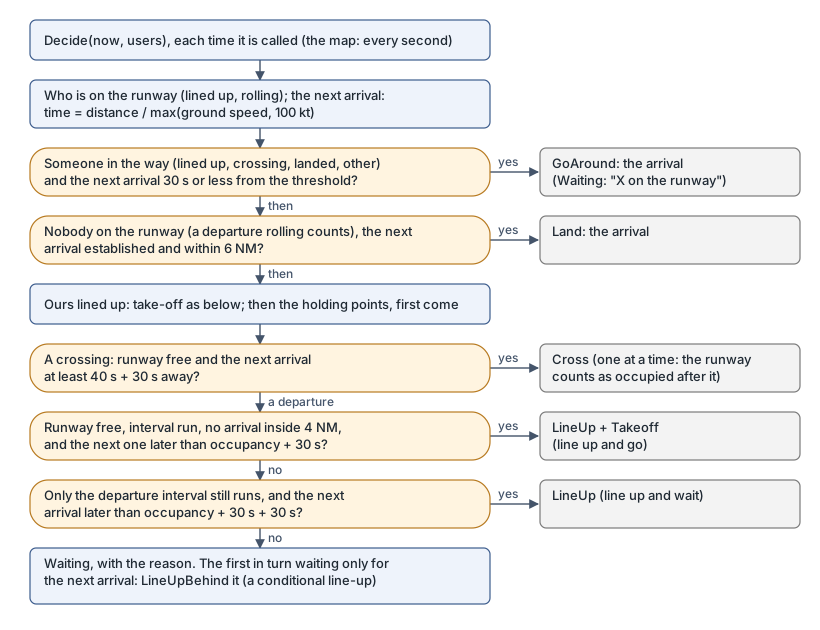
RunwayController.Decide (pkg/traffic/runway_control.go, #393) is the tower of one runway. On the airport map it is called every second with the runway’s users.
| Option | Default | Use |
|---|---|---|
MinArrivalNM |
4 NM | no take-off with an arrival inside it |
Margin |
30 s | added to the occupancy (take-off) or crossing time |
CrossTime |
40 s | how long a crossing takes |
GoAroundAt |
30 s | an arrival this close with the runway not free goes around |
ClearToLandNM |
6 NM | the next established arrival is cleared to land within it |
LineUpTime |
60 s | a departure at a holding point takes this to line up |
Time to the next arrival = distance ÷ max(ground speed, 100 kt). A departure may take off when all of these hold:
- nobody else is on the runway (every occupant counts, not only the one listed last);
- the interval since the last departure began its roll has run (
DepartureInterval, below); - no arrival is inside 4 NM;
- the next arrival lands later than this departure’s runway occupancy plus 30 s, and, from a holding point, plus its
LineUpTimetoo.
The occupancy is RunwayOccupancyIn: departing 40 s (light), 45 s (medium), 50 s (heavy), 60 s (super). It is 15 % longer on a wet runway and 40 % longer on a contaminated one. A medium on a dry runway lined up needs the next arrival 75 s away, about 2.9 NM at 140 kt, so the 4 NM rule decides first. From a holding point it needs 135 s, about 5.3 NM at 140 kt.
Only an arrival established on the final is sent around (GoAround); one on its procedure passing near the threshold is not. On the airport map, a take-off clearance given to a departure not yet rolling is cancelled (“hold position, cancel take-off”) for someone on the runway, or for an arrival inside 3 NM (cancelInsideNM), not one just under the 4 NM it was cleared at. A departure told to line up behind an arrival that then goes around is cleared afresh.
At the holding points, departures and crossings go first come, first served, by when each was first seen holding:
- A departure that may take off gets line-up and take-off together. If only the interval still runs and the arrival leaves the line-up time, the occupancy, 30 s and another 30 s, it gets “line up and wait”.
- If the runway is taken by one of ours lined up, the departure is “number N for departure”; otherwise it waits for “X on the runway”.
- The first departure in turn that waits only for the next arrival (the interval has run) gets
LineUpBehind: line up behind that arrival once it has passed. - A crossing needs the runway free and the next arrival at least 40 s plus 30 s away. One aircraft crosses at a time.
Go-around. The next arrival is sent around when it is 30 s or less from the threshold and someone is in the way. In the way means lined up, crossing, still on the runway after landing, or other traffic on it. A departure already rolling does not count.
Landing clearance. The next arrival is cleared to land when the runway is empty, a departure on its roll included, and the arrival is ours, established on the final and within 6 NM.
Departure intervals (wake.go, DepartureInterval):
| Leader → follower | Interval |
|---|---|
| any, diverging routes | 1 min (DefaultDepartureInterval) |
| same route (SID) | 2 min (SameRouteDepartureInterval) |
| heavy → medium or light | 2 min (WakeDepartureInterval) |
| super → heavy or super | 2 min |
| super → medium or light | 3 min (WakeSuperDepartureInterval) |
The longest of the route and wake intervals applies.
Spacing on final
ArrivalSpacing (conditions.go) starts from the wake minimum of the pair (ArrivalSeparationNM in wake.go), at least MinRadarSeparationNM (3 NM):
- ICAO: J→H 6, J→M 7, J→L 8, H→H 4, H→M 5, H→L 6, M→L 5 NM; other pairs 3 NM.
- RECAT-EU (
SchemeRecat): the A–F matrix inrecatArrivalNM.
The code comments attribute these values to ICAO Doc 4444 and RECAT-EU. The conditions then change the spacing:
| Condition | Effect | Constant |
|---|---|---|
| 3 NM pair, reduced separation allowed: dry runway, visibility ≥ 5000 m and ceiling ≥ 1000 ft (0 counts as good) | 2.5 NM | ReducedRadarSeparationNM, ReducedVisibilityM, ReducedCeilingFt |
| Contaminated runway (snow, or rain at or below 0 °C) | +1 NM | ContaminatedExtraNM |
| Low visibility: visibility under 550 m or ceiling under 200 ft | at least 6 NM | LVPSpacingNM, LVPVisibilityM, LVPCeilingFt |
Sequencing
ApproachSequencer.Update (sequencer.go, #390) orders the arrivals of one runway end.
ETA. The distance to go is flown at the ground speed now (at least the final ground speed), the last FinalNM (10 NM) at the average of the two, and inside 10 NM at the final ground speed. The final ground speed is max(80, final airspeed − headwind), with a final airspeed of 140 kt by default. For example, 30 NM to go at 250 kt in calm air: 20 NM ÷ 250 + 10 NM ÷ 195 = 7 min 53 s.
Gap. The gap between two landings is the spacing flown at the follower’s final ground speed. With TimeBased, the airspeed is used instead, so a headwind does not stretch the time. The gap is at least the leader’s landing occupancy on the surface: 45, 50, 60 or 70 s for light, medium, heavy or super. Examples in calm air at 140 kt:
| Leader → follower | Spacing | Gap |
|---|---|---|
| B77W (H) → A320 (M), ICAO | 5 NM | 2 min 9 s |
| the same, RECAT-EU (B → D) | 4 NM | 1 min 43 s |
| A320 → A320 | 3 NM | 77 s |
| A320 → A320, reduced allowed | 2.5 NM | 64 s |
| A320 → A320, 20 kt headwind (distance kept) | 3 NM | 90 s |
Order. Arrivals inside FreezeNM (8 NM), or Fixed, keep their predicted time. The others are taken first come, first served, by the prediction they had when they joined, or their prediction now if it is earlier (a shortcut). Two of them change places only when their keys part by more than SwapMargin (90 s). Each takes the earliest time that keeps the gap behind the one before it, and is pushed behind any planned landing it would come within a gap of. Its delay is that time minus its ETA. A delay change under DelayStep (30 s) is not reported. Move lets a controller change the order, and Rejoin re-sequences an arrival after a go-around like a newcomer. The airport map uses MinSpacingNM 5 (sepMinNM), so 5 NM is the least spacing whatever the wake.
Delay absorption
PlanAbsorption and ArrivalController.AbsorbDelay (absorb.go, #391) lose a delay on the STAR, before the final. The align and join points are never changed.
- Speed. The new speed is
STAR NM ÷ (STAR NM ÷ speed + delay), rounded down to tens of knots, if that is not belowMinProcedureSpeedKts(210 kt, turbopropsMinProcedureSpeedTurbopropKts170 kt). For example, 40 NM at 250 kt with a 1 min delay gives 226 kt, assigned as 220 kt. An arrival already flying that speed is not told it again. - Path. At the minimum speed, the rest is extra track:
remaining time × minimum speed, at mostMaxStretchNM(30 NM). Where the STAR ends on a downwind, the downwind is extended (a trombone, each mile out adds two). Otherwise a dog-leg is flown on the longest leg ahead, away from the centreline, if that leg is at leastMinStretchLegNM(3 NM). Less than 1 NM is not worth a turn. For example, 40 NM at 250 kt with a 3 min delay: 210 kt absorbs 110 s, and the other 70 s is 4.1 NM of track. - Hold. Whatever is left goes to the hold.
On the airport map (cmd/airport-map/sequence.go):
- a delay is absorbed once it reaches 30 s (
absorbFrom), at most every 90 s per arrival (absorbEvery); - an arrival holds when 1 min or more is left (
holdFrom); - it leaves the hold when its delay is down to 1 min (
holdRelease).
Closing up on the final. An established arrival keeps its predicted time, so the sequencer cannot delay it. Instead it reports ShortBy: how much sooner than its spacing the arrival would land behind its leader. From 10 s short (spacingActFrom), the map acts before they meet:
- Still on its STAR or downwind, the shortfall is absorbed like a delay: speed, then a longer downwind.
- On the injected final, the arrival flies its final approach speed from now on, instead of slowing to it on the way: “number 2, for spacing reduce to final approach speed” (
ReduceToFinalSpeed). - It is sent around early, not on short final, if all of these hold 20 s after it was slowed (
breakOffAfter): it is still 25 s or more short (breakOffFrom), more than 3 NM out (breakOffNM), and already inside its spacing behind the leader, measured now along the track. The go-around re-sequences it, and the tower clears its next approach again.
Holds
The holds are ours, not the simulator’s (hold.go, #392):
- Where: the first STAR point at least 15 NM from the threshold on the map (
holdFixNM), with the STAR’s inbound course. - Speed and legs: 230 kt up to 14,000 ft, 240 to 20,000, 265 to 34,000, 280 above (
HoldSpeedKts). The outbound leg is 1 min up to 14,000 ft and 1.5 min above (HoldLegTime). Turns are rate one. - Entry (
Hold.Entry), measured from the inbound course for right turns (mirrored for left): direct from 70° on the non-holding side round to 110° on the holding side, teardrop for the next 70°, parallel for the remaining 110°. - Stack (
HoldStack): levels 1000 ft apart from 6000 ft on the map (holdBaseFt). Aircraft leave from the bottom, and the ones above step down.
Conflicts
PredictConflicts (conflict.go, #395) flies every pair of airborne aircraft on as they are: track, ground speed and vertical speed. A vertical speed under 300 fpm counts as level. It looks ahead LookAhead (5 min) in Step (10 s) steps. A pair is in conflict when it is closer than both minima at the same step:
- lateral
EnrouteSeparationNM(5 NM), orTerminalSeparationNM(3 NM) when both are at an airport and below 10,000 ft; - vertical
VerticalSeparationFt(1000 ft).
Pairs are skipped when the tower separates them (TowerPair: same airport, one below TowerBelowFt, 2500 ft above the ground) or when they cannot meet within the look-ahead. The airport map uses 5 NM in both cases (conflictOpts) and checks every 5 s.
ResolveConflict tries changes to one of ours, cheapest first, and takes the first that keeps it clear of everyone through the look-ahead. Both aircraft are tried; on equal cost the first aircraft of the pair is chosen. Other traffic is never steered.
| Change | Cost |
|---|---|
| Speed × 0.9 or × 1.1 (not above 250 kt below 10,000 ft) | 1.5 |
| Speed × 0.8 or × 1.2 | 2.0 |
| Level ±1000 ft (at 1500 fpm, not below 1500 ft above the ground) | 2.5 |
| Level ±2000 ft | 3.0 |
| Level against the semicircular rule (level at 10,000 ft or above: odd thousands eastbound) | +1 |
| Heading 20° right / left | 3.44 / 3.54 |
| Heading 30° right / left | 3.67 / 3.77 |
| Heading 45° right / left | 4.0 / 4.1 |
The resolved aircraft flies the change for the look-ahead and then goes back to its route (ResolvedRoute). On the map it is not steered again for 5 min. Two of our arrivals on their STARs are not steered by the en-route resolver. Instead, the one landing later loses time (speed, then a dog-leg). If it is still in conflict 90 s later, it holds (#455, cmd/airport-map/conflicts.go).
Checking a decision
These are the places that show a decision:
- Pushback:
TaxiController.PushFacing()gives the compass facing of the planned push. The taxi route on the map shows the push and the route. - Ground stops:
TaxiEvent.PushbackHeldreports a held push. The aircraft a taxiing one gives way to is kept ingroundDrive.givingWay, which is internal. - Runway:
RunwayClearances.Waitinggives the reason each departure or crossing waits.GET /api/runways?icao=lists each runway’s users on the map. - Sequence:
SequenceEntryhasNumber,Leader,SpacingNM,SpacingWhy,ETA,LandingandDelay.Absorption.String()says how a delay is lost (“210 kt, +4.1 NM”). - Conflicts:
GET /api/separationreturns the closest pairs, the conflicts and the resolutions on the map (Keeping apart).